Escapism by Yi-Fu Tuan
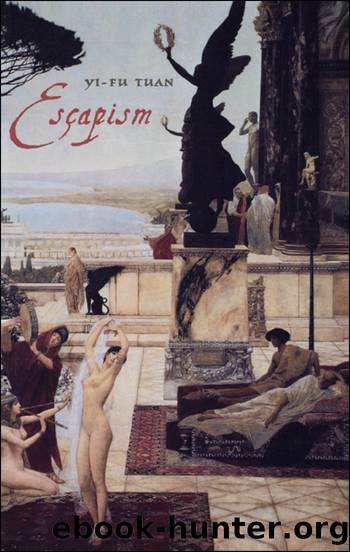
Author:Yi-Fu Tuan
Language: eng
Format: epub
Publisher: Johns Hopkins University Press
Published: 1998-02-14T16:00:00+00:00
CRUELTY IN PRIMITIVE SOCIETIES
In âcivilizedâ societies the same sort of disciplined imagination that creates wonders of intellectual and spiritual uplift is able to create unspeakable horrors of degradationâliteral hells. In disgust, we look to earlier times and simpler (more primitive) societies for reassurance. Can it be found there?
âPrimitiveâ is now considered a derogatory word to be avoided by speakers of good will. But its root meaning has no bad odor. Rather than its current sense of âcrude,â it meant simply âearlyâ or âoriginal.â Thus, the primitive church is one where doctrine has been preserved in purity, uncontaminated by later vain excrescences. Primitive people are people who have retained the innocence and virtues of an earlier golden age. But if âprimitiveâ as crude is not to be used, is âprimitiveâ as pure apt? Are thereâhave there ever beenâsuch unfallen people? Books that romanticize them regularly appear. They do not, however, tell the whole story. In such books dark facts, although they are known to the author, tend to be downplayed. What are these facts? What is the nature of the primitive peopleâs offense? Their offense is the all too commonplace sort that the ânormalâ commit against the âdeviant,â the strong against the weak.
All societies contain the strong and the weak, and the weak are inevitably at the mercy of the strong, unless, mirabile dictu, a high collective standard of justice is conceived and imposed. Consider the Mbuti of the Congo rain forest. They have been idealized by Colin Turnbull in his widely read book The Forest People. The Mbuti indeed have many endearing traits, outstandingly their warmth toward one another. But outsiders, such as the Bantu agriculturalists who share the forest with them, are beyond the pale, not fully human, beings against whom cheating and stealing are permissible. Mistreating weak members of their own group also appears to be morally unproblematic, in the order of things. The Mbuti esteem verbal cleverness and despise dumbness, which they associate with animals. A young man who happens to be a deaf mute is the camp clown and mercilessly teased for his stuttering speechââanimal noises,â as his fellow campers call it. The teasing goes beyond just high spirits. On one occasion, the deaf-mute youth climbed a tree with a companion to collect honey. The task has its risks, which are nevertheless worth taking because honey is for the Mbuti the forestâs single most desirable gift. Back on the ground, the youth rattled his rusted tin cup and with gestures and noises indicated that he wanted his share. He was roundly ignored.12 Would an appeal to justice, or fairness, have made any sense? Fairness does make sense within a kin group, or among equals, for reciprocity is the key to survival. But it does not apply to those with a physical handicap, who have nothing to offer the common life other than as figures of fun.13
The closeness of primitive people to the world of living things, particularly animals, has often been noted by Western observers. To
Download
This site does not store any files on its server. We only index and link to content provided by other sites. Please contact the content providers to delete copyright contents if any and email us, we'll remove relevant links or contents immediately.
| Anthropology | Archaeology |
| Philosophy | Politics & Government |
| Social Sciences | Sociology |
| Women's Studies |
Born to Run: by Christopher McDougall(7127)
The Leavers by Lisa Ko(6948)
iGen by Jean M. Twenge(5416)
Sapiens by Yuval Noah Harari(5370)
Spare by Prince Harry The Duke of Sussex(5197)
The Kite Runner by Khaled Hosseini(5179)
Machine Learning at Scale with H2O by Gregory Keys | David Whiting(4313)
Bullshit Jobs by David Graeber(4190)
Never by Ken Follett(3957)
Goodbye Paradise(3810)
Livewired by David Eagleman(3774)
Fairy Tale by Stephen King(3399)
A Dictionary of Sociology by Unknown(3085)
Harry Potter 4 - Harry Potter and The Goblet of Fire by J.K.Rowling(3074)
The Social Psychology of Inequality by Unknown(3031)
The Club by A.L. Brooks(2925)
Will by Will Smith(2920)
0041152001443424520 .pdf by Unknown(2846)
People of the Earth: An Introduction to World Prehistory by Dr. Brian Fagan & Nadia Durrani(2738)
